
 Eesti
Eesti
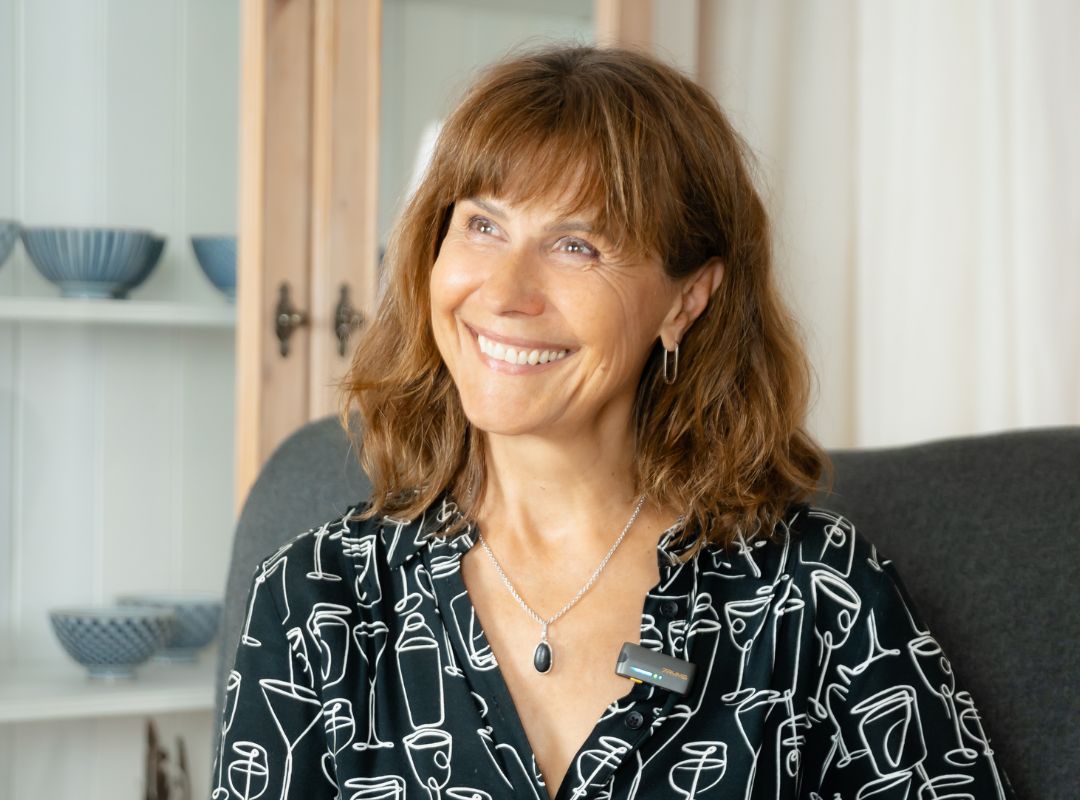
We met with Rita on a spring morning on the outskirts of Tallinn and found ourselves deep in conversation almost immediately, surrounded by the hum of a café. We spoke about mental health, designing one’s life, and the idea that life doesn’t need to be taken too seriously. Rita embodies warmth, balance, and wisdom — with, in my eyes, a subtle rock’n’roll spark.
WHO ARE YOU?
Rita Rätsepp doesn’t answer the question “Who are you?” in the way people usually expect. She doesn’t begin listing roles — actress, psychologist, trainer, mother of three adult children, grandmother.
Yes, she is all of that. But she pauses and simply says:
“I am Rita. Rita. Rita.”
This is neither ego nor modesty. It is clarity.
“We like to define ourselves through roles, but those are constantly changing. I am the one who lives those roles,” she explains.
This perspective sets the tone for our entire conversation — identity is not fixed, but fluid. What matters is who you are beneath the roles.
WHEN LIFE PULLS THE RUG OUT FROM YOU
Rita doesn’t speak about change in theory. She speaks from experience. Life brings moments when everything seems to fall apart — relationships, work, inner balance. The question is not if these moments come, but when.
“Change is always a shock. The brain doesn’t know whether it’s good or bad — it only knows that something is different. In these moments, people instinctively try to regain control. Often, in the wrong places. We worry about things we cannot influence. But that gives us nothing except anxiety and exhaustion.”
Her work as a psychologist has taught her to distinguish between two levels: what we can control and what we cannot. It sounds simple, but in practice, it is one of the most difficult skills to master.
“When you bring your focus back to what you can do — even something very small — life starts moving again. It’s important to understand that the direction to aim for is trusting life. But it’s not always easy, and it may not suit everyone. At the same time, it’s important to accept that where you are right now is okay. Just start moving from there.”
LIFE DOESN’T CHANGE OVERNIGHT
Rita doesn’t believe in radical transformations. Nor does she believe in motivational speeches that promise quick results.
“People want to run a marathon immediately. But life doesn’t work that way.”
Her approach is almost boring in its simplicity: do one thing differently. Then another. And another.
“You don’t have to change your whole life. It’s enough to change one pattern — everything starts to unfold from there.”
Today, this is often called “life design.” Rita doesn’t really use the term, but she lives it intuitively.
THE BODY AS A SYSTEM, NOT A PROJECT
When the conversation turns to self-care, her tone becomes practical. There is no philosophy here — only discipline.
“The body is a system. If you don’t maintain it, it doesn’t function.”
She doesn’t speak about beauty standards or self-improvement, but about natural balance.
“I like order. It brings peace. When things are in order around me, they are in order inside me — and vice versa. Everything in this world works both ways.”
For her, morning exercise, beauty routines, and evening care are part of mental hygiene — not an obligation, but a way to stay balanced.
WHY PLANS DON’T ALWAYS WORK
When asked about the future, an interesting shift appears. Rita doesn’t talk about goals.
“I don’t think about where I’ll be in five years. I think about the direction I’m moving in today. That difference matters. A goal is a fixed point. Direction is movement. If you set yourself a very specific goal, life has to conform to it. But life doesn’t conform.”
Instead, she focuses on a feeling:
“What do I want to feel in my life right now?”
That question guides her decisions more than any strategy.
RESPONSIBILITY AS FREEDOM
One of the sharpest moments in the conversation comes when we speak about responsibility.
“No one can simply make me angry. If I get angry, I have to look within — what happened in me that I reacted that way? This is not semantics. It’s a paradigm. When a person takes responsibility for their reactions, the need to blame others disappears — and with it, part of the suffering.”
“We spend an enormous amount of energy explaining why someone else is to blame. But it doesn’t change anything. What happened, happened. The question is what you do with it today.”
LONELINESS AS A MODERN EPIDEMIC
Rita describes loneliness as a pandemic — not metaphorically, but literally.
“There are countries that have ministers of loneliness. The paradox is obvious: we are constantly connected, yet feel disconnected. In her view, the issue is not a lack of contact, but a lack of connection with oneself.”
“If you are not in contact with yourself, you are not in contact with others”, she said.
“Being alone is not the problem. The problem is when a person cannot tolerate their own company.”
SILENCE AS WISDOM AND LUXURY
One theme Rita returns to repeatedly is pause.
“The brain needs silence and rest to create new connections. In today’s information environment, this has become a luxury. People fill every moment — with screens, sound, movement. Silence feels uncomfortable. We subconsciously avoid ourselves. But it is exactly there, in silence and discomfort, that things begin to settle.”
She speaks of a simple practice: to just be. To watch clouds. To walk without a goal. To sit on a park bench and observe people — not for productivity, but for presence. She describes her own playful observation habit:
“I’ve sat on outdoor terraces watching people, trying to understand their mindset — where they come from, why they behave the way they do.”
It sounds like a beautifully simple way to spend time. Another suggestion she gives:
“Go into nature without a goal. Observe it. We’ve become too urban.”
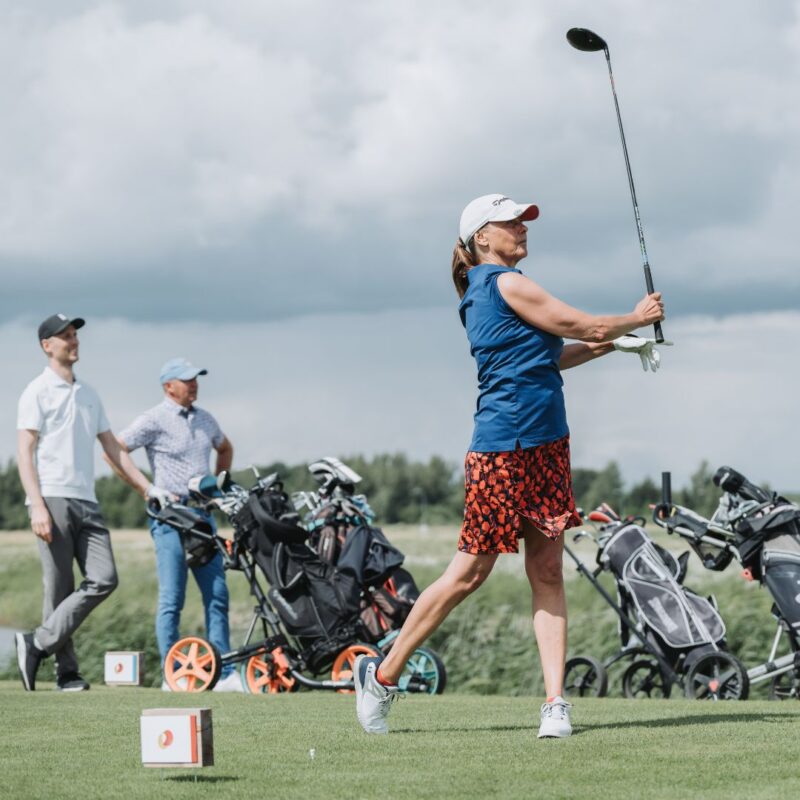
Golf is one of her long-time hobbies — one of the ways she shifts her mind and spends time in nature.
Pause can also be culture — a good book, theatre, music. Something that takes you out of autopilot and makes you notice. When I ask her for a cultural recommendation, she answers simply:
“Don’t take life too seriously!”
She suggests the Estonian horror-comedy Chainsaws Were Singing (2024), in which she plays the Killer’s mother.
As an interviewer, I admit I haven’t seen it — horror isn’t usually my genre. But after this remarkable conversation, I might just make an exception.
Pause can also be a daily ritual — like evening skincare, which she describes as a conscious slowing down. A moment where you’re not fixing yourself, but caring for yourself.
This mindset is also at the heart of Pestle & Mortar — not just as a beauty brand, but as a creator of calm rhythm. Something that doesn’t accelerate, but slows down. Something that helps you pause and feel cared for.
Rita doesn’t speak only about product functionality — her experience begins with how the logo and packaging make her feel. It’s all part of one whole.
LIFE IS NOT A PROBLEM TO SOLVE
At the end of our conversation, Rita summarizes her philosophy succinctly:
“Life is not a problem to solve. It is a process to experience. This also means letting go of the constant need to fix things. Not every discomfort needs a solution — some things simply need space. If you are constantly fixing, you are not living.”
And perhaps this is the most important takeaway: life doesn’t get better when we do more. Life gets better when we begin to notice it — when we pause, when we seek the feeling we truly want, and when we are willing to change our patterns, one small step at a time.
Let’s remember: we are part of a whole. Everything is connected.
Rita’s favourite products from Pestle & Mortar
“My favourites are the Pure eye masks — refreshing and truly effective. I also love the Hydrate moisturiser. You only need a tiny amount and it absorbs perfectly. The feeling is amazing, and when you add a vitamin C serum, the freshness and results are visible. The Recover eye cream is an absolute favourite. Again, you need very little. It absorbs well and is highly effective. I might just become addicted to it.”
PESTLE & MORTAR Pure Hyaluronic Hydrogel Eye Patches (30 pairs/60 pieces per box)
PESTLE & MORTAR Hydrate Lightweight Moisturiser (50ml)
PESTLE & MORTAR Vitamin C 2 Phase Serum, 16% Vitamin C (40ml)
PESTLE & MORTAR Recover Nourishing Eye Cream (15ml)
Interview by Kristiina Kullo, co-founder of Sisbond
